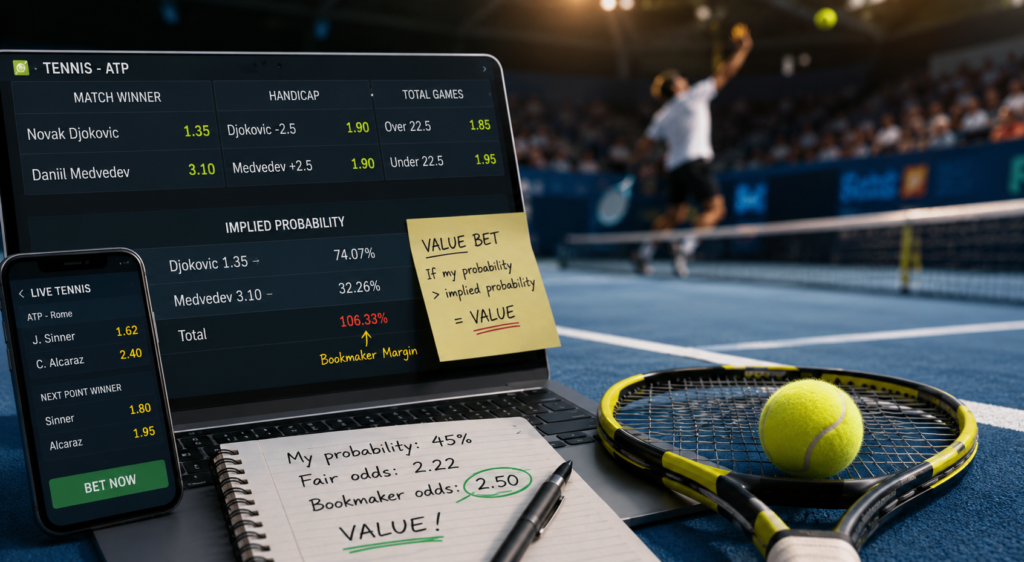
When seeing betting odds, most people think about one thing only: who will win? But that’s only part of the story. Odds are also a price. They are like the price of a tennis racket or a concert ticket, they tell you what you’re paying for a certain opportunity. Once you begin to think of odds like that, it becomes a lot more interesting to wager.
Odds Are More Than Predictions—They’re Market Prices
This is probably one of the easiest sports to understand this concept for tennis. The game is between only two players, there are a plethora of statistics, and the markets are always in motion before every game. A player with a price of 1.40 is a strong favourite and a player with a price of 3.20 is expected to win significantly less often. But those numbers don’t simply predict the future. They also indicate the risk assessment by the bookmaker, and the amount the bookmaker is willing to “sell” on each of the outcomes.
When you’ve come to a point of making a bet on table tennis, you will probably have seen that the rates fluctuate before a game begins, especially on websites such as 22Bet. Because as new information comes in, and betting patterns change, that is what bookmakers do. Another advantage of 22Bet is the extensive choice of tennis and table tennis markets offered daily, enabling savvy bettors to do a price comparison instead of just going with the streamlined favorite.
Here’s how bookmakers actually do it. The bookmakers do not simply pick out random numbers. They use multiple sources of information.
- Historical player performance.
- Surface statistics, since clay, grass and hard courts produce different results.
- Head-to-head records.
- Injuries and recent fitness updates.
- Market activity once bettors begin placing wagers.
Imagine Novak Djokovic playing against a player lower than top 100 in the world on hard courts. Analysts can only come up with an approximate 85% to 88% chance Djokovic has of winning before the bet. That probability is the baseline that is adjusted as cash comes into the market.
Probability Comes First
Odds are simply another way of expressing probability.
Here’s a simple example:
| Decimal Odds | Implied Probability |
| 1.50 | 66.7% |
| 2.00 | 50% |
| 3.00 | 33.3% |
| 5.00 | 20% |
When a player is offered at 2.00, this is a good indication that the bookmaker thinks the player has approximately a 50% chance of winning. The method of calculating is simple: 100 divided by the decimal odds.
For of course, there is no such thing as a perfect reality.
The Bookmaker’s Margin
In order to earn a profit, bookmakers price in a margin on any market. This can be referred to as “overround”.
Imagine that two players of tennis are just one and the same. Both should be $2.00 in theory. Rather, an online bookmaker can provide both at 1.91. The total implied probability, now exceeding 100%, is what gives the bookmaker a room for profits in the long run.
This spread is typically very close for big ATP and WTA games as there is lots of competition among sportsbooks.
So, what is a Value bet?
It is where the knowledgeable bettors differ.
A value bet does not imply a guarantee that the player is going to win. It means that it costs less than the real odds.
For example:
1. You think Player A has a probability of 45% for winning.
2. It would then be approximately 2.22 to 1 against fair odds.
3. A bookmaker offers 2.50.
4. The price can still be a value even though Player A has lost today.
Sports bettors who are not professionals are not concerned about predicting every winner; they’re just concerned about this difference.
Many of the great tennis wagers take it upon themselves to say that they don’t buy wins, they buy good prices.
Why Prices Move Before a Match
Odds change very rarely. Takes in new information quickly.
Some of the most popular ones are:
- Injury information at the start of training.
- Unusual weather situations for outdoor tournaments.
- A significant amount of wagering by one player.
- Emergence of new statistical models that are becoming available.
The market may overreact at times. At other times it doesn’t respond sufficiently. That’s the kind of time hunters dedicate to hours of hunting for those moments.
It is actually in the end simpler to grasp tennis betting once you don’t take odds as predictions and consider them as prices. Each number is a representation of probability, bookmaker risk and market opinion all in one. When you next play a match comparing two players, ask yourself not only who’s stronger. Question if price is a good reflection of the player’s actual odds of winning. It’s the question that will set the casual betters apart from the ones who think several steps ahead.